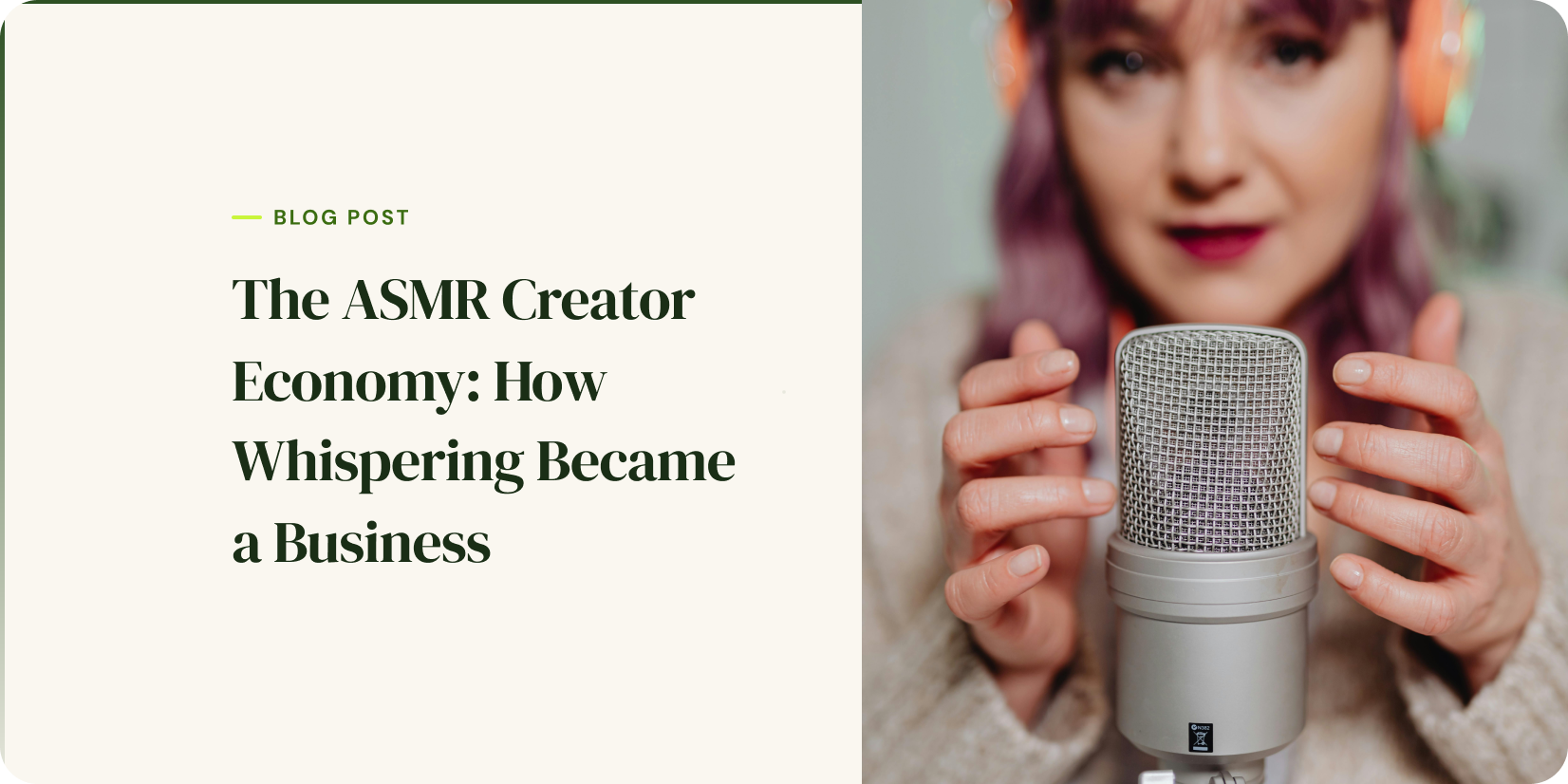
If you explain the premise of an ASMR (Autonomous Sensory Meridian Response) video to a traditional media executive, they will probably laugh. A creator sits in a quiet room, whispers into a highly sensitive microphone, taps on a glass bottle for forty minutes, and millions of people watch it to fall asleep.
It sounds absurd. Until you look at the economics.
ASMR is not just a weird internet subculture; it is a massive, highly optimized industry. Top ASMR creators (often called "ASMRtists") are running multi-million dollar media businesses. But what makes the ASMR creator economy truly fascinating is not just the scale of the audience—it is the structural advantages of the business model itself.
Here is why whispering into a microphone is one of the best businesses on the internet, and what traditional creators can learn from the economics of relaxation.
The Production Cost Advantage
Most high-level creators are trapped in an escalating arms race of production value. MrBeast spends millions of dollars per video. Travel vloggers spend thousands on flights and drones.
ASMR creators operate with a fundamentally different cost structure. The entire format relies on intimacy and simplicity. Once an ASMR creator purchases a high-end binaural microphone (typically $1,000 to $3,000) and soundproofs their recording space, their marginal cost of production drops to near zero.
There are no expensive sets to build, no massive crews to hire, and no complex VFX to render. A creator can produce three 45-minute videos a week with nothing but a microphone, a camera, and a few household objects. This gives ASMR creators some of the highest profit margins in the entire creator economy.
The Watch Time Anomaly
The YouTube algorithm optimizes for two primary metrics: Click-Through Rate (CTR) and Average View Duration (AVD).
Most creators fight brutally to keep viewers engaged for 10 or 15 minutes, using fast cuts, loud music, and constant visual stimulation. ASMR creators bypass this fight entirely because their content serves a specific functional purpose: sleep and anxiety relief.
Viewers routinely put on a 60-minute ASMR video and let it play all the way through while they fall asleep. This results in Average View Durations that are mathematically impossible for traditional entertainment channels. Because the algorithm heavily rewards total watch time, ASMR videos are frequently pushed by the recommendation engine, creating a massive, organic top-of-funnel growth loop.
The Custom Content Economy
While ASMR channels generate significant AdSense revenue (despite some advertiser hesitation around the intimacy of the format), the real financial engine of the ASMR economy is direct fan monetization.
Because ASMR is highly personal—different people have very specific "triggers" that relax them—there is massive demand for custom content.
ASMR creators monetize this demand through Patreon and direct commissions. A creator might charge $50 to $200 for a 10-minute custom video featuring specific triggers requested by a fan. On Patreon, fans gladly pay $5 to $20 a month for ad-free audio files, early access to videos, or exclusive live streams.
This creates a highly resilient revenue stack. If YouTube changes its algorithm or advertisers pull back, the ASMR creator is protected by a moat of recurring subscription revenue and high-margin custom commissions.
The Loyalty of Relief
The most powerful asset an ASMR creator has is the psychological bond they form with their audience.
Traditional creators provide entertainment. ASMR creators provide relief. When a creator helps someone manage their insomnia, cope with a panic attack, or simply decompress after a brutal workday, the audience loyalty is absolute.
This loyalty translates directly into financial stability. ASMR audiences have incredibly low churn rates on Patreon and high conversion rates for creator-owned merchandise (like sleep masks, branded teas, or relaxation apps).
Financing the Quiet Empire
Even with high margins, scaling an ASMR business requires capital. Upgrading to professional-grade binaural audio equipment, building a dedicated soundproof studio, or launching a physical product line takes cash.
Instead of taking on debt or selling equity, top creators use their massive back-catalog of evergreen content as a financial asset. Because ASMR videos do not age out of relevance (a tapping video from 2019 is just as relaxing today), they generate highly predictable AdSense over time.
By using a platform like CreatorFi, an ASMR creator can secure an advance on that future AdSense revenue. They can pull forward the cash generated by their old videos to fund their new studio, all without taking on a sponsor that might disrupt the relaxing environment they have built.
The Ultimate Utility
The ASMR economy proves a fundamental rule of the internet: utility beats pure entertainment.
When you solve a real problem for your audience—even if that problem is just getting to sleep—you don't have to scream to build a business. You just have to whisper.

Frequently Asked Questions
How do ASMR creators make money?
ASMR creators make money through a diversified revenue stack: YouTube AdSense (driven by massive watch times), Patreon subscriptions for ad-free or exclusive content, custom video commissions, brand sponsorships (often with sleep, wellness, or tech brands), and merchandise.
Why do ASMR videos perform so well on the YouTube algorithm?
The YouTube algorithm heavily rewards Average View Duration (AVD) and total watch time. Because viewers use ASMR videos to fall asleep or study, they often let 45-to-60-minute videos play all the way through, giving ASMR creators engagement metrics that traditional entertainment channels cannot match.
What are the production costs for an ASMR channel?
After the initial investment in high-quality audio equipment (like a 3Dio binaural microphone) and a quiet, sound-treated recording space, the ongoing production costs are incredibly low. ASMR relies on simplicity and intimacy rather than expensive sets, crews, or complex editing.
Why is Patreon so popular in the ASMR community?
Patreon is popular because ASMR is a highly personal experience. Fans have specific "triggers" they prefer and often want to listen without the interruption of YouTube mid-roll ads. Patreon allows creators to offer ad-free audio downloads, exclusive triggers, and custom content directly to their most dedicated fans.
How can an ASMR creator fund a new studio or equipment upgrade?
Instead of taking out a traditional loan, an ASMR creator can use specialized financing like CreatorFi. By leveraging their highly predictable, evergreen back-catalog of videos, they can secure an AdSense advance to fund a studio buildout or equipment upgrade without disrupting their cash flow.
Learn more about financing your creator business at creatorfi.finance/youtube