The Creator Economy in Japan: Why the World's Third-Largest Economy Plays by Different Rules
When Western creators talk about the "creator economy," they are usually talking about a very specific, Silicon Valley-funded ecosystem: YouTube AdSense, Instagram brand deals, Substack subscriptions, and Shopify merchandise.
But in Japan, the third-largest economy in the world and a cultural exporter of massive global influence, the creator economy looks fundamentally different.
In Japan, the highest-earning creators do not show their faces. The most powerful entities are not individual influencers, but massive talent agencies that trade on the Tokyo Stock Exchange. And the primary revenue driver is not advertising, but a deeply ingrained culture of direct fan support and character IP licensing.
Here is why the Japanese creator economy plays by different rules, and what Western creators can learn from a market that has already solved the monetization problems we are just beginning to face.
The VTuber Revolution and the Death of the Face
In the West, a creator's face is their primary asset. In Japan, a creator's face is increasingly seen as a liability.
The dominant force in the Japanese creator economy is the VTuber (Virtual YouTuber)—creators who stream using animated, motion-captured avatars. What started as a niche subculture in 2016 has exploded into an $800 million industry.
From a business perspective, the VTuber model is a masterclass in risk management. When a Western creator burns out, ages out of their demographic, or gets involved in a scandal, the business collapses because the business is the person. A VTuber, however, is character IP. The avatar never ages. If the human actor behind the avatar leaves, the agency can theoretically recast the role, much like a theme park character or a superhero franchise.
This decoupling of the creator's physical identity from their digital brand allows Japanese creator businesses to scale and protect their equity in ways Western creators cannot.
The Agency Model vs. The Solo Creator
The Western creator economy celebrates the "solo creator" or the small indie team. The Japanese creator economy is heavily institutionalized.
The biggest VTubers in the world do not operate independently; they are signed to massive talent agencies like Hololive (Cover Corp) and Nijisanji (Anycolor). These agencies function like a hybrid between a Hollywood studio, a tech startup, and a K-pop management company. They provide the expensive motion-capture technology, book the brand deals, manufacture the merchandise, and organize massive stadium concerts.
In exchange, the agency takes a significant cut of the revenue and retains ownership of the character IP. While Western creators would balk at giving up their IP, the Japanese model trades total ownership for massive institutional scale. This is why Cover Corp and Anycolor are publicly traded companies worth hundreds of millions of dollars, while Western creator networks struggle to reach venture-scale valuations.
The Economics of "Oshi" Culture
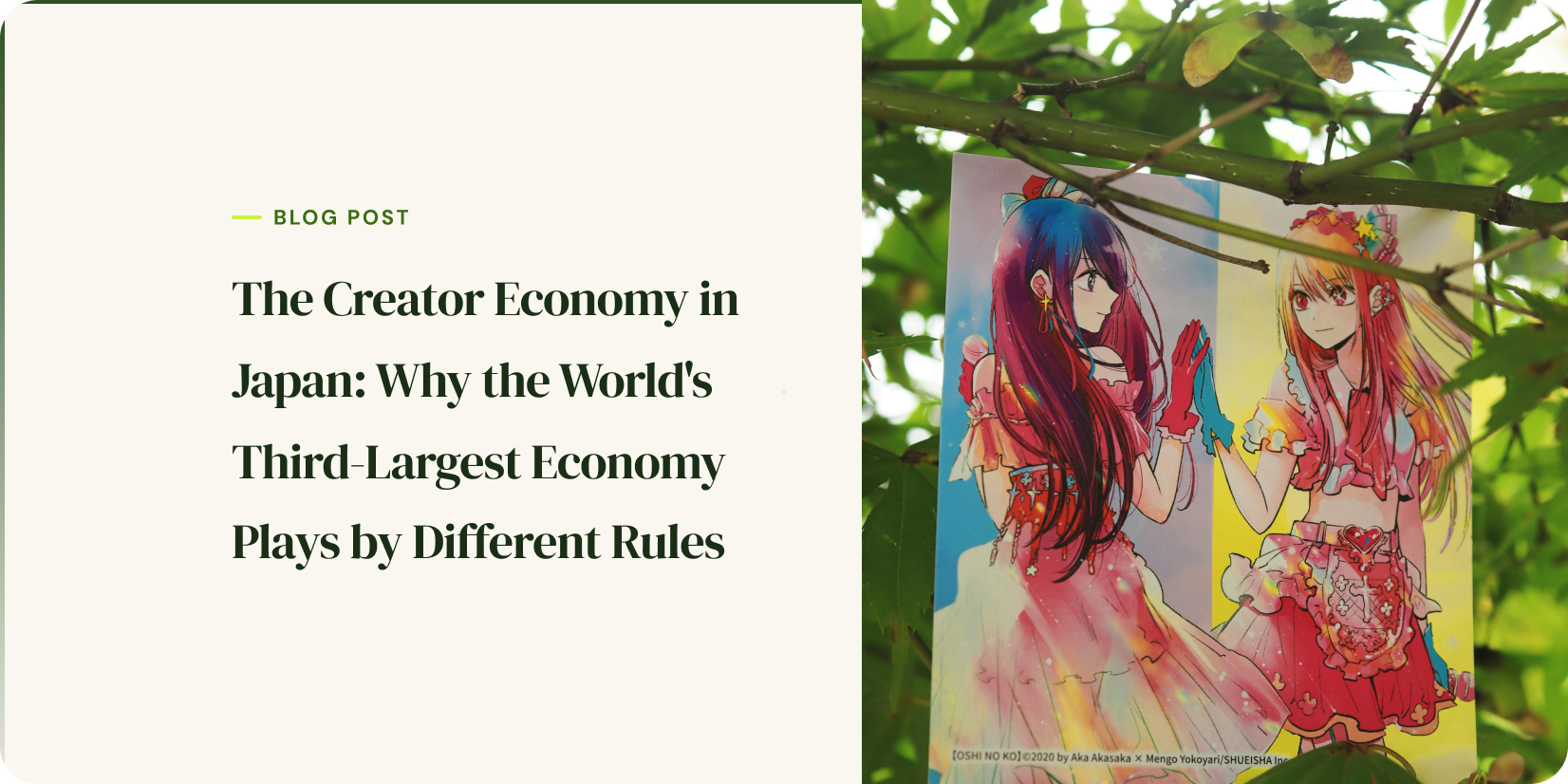
If you want to understand Japanese creator monetization, you have to understand Oshikatsu (the act of supporting your favorite idol or character).
In the West, fans buy a creator's merchandise because they like the design or want to support the channel. In Japan, direct financial support is culturally formalized. Fans engage in Super Chat tipping on YouTube not just to get noticed, but as a dedicated financial obligation to ensure their "Oshi" succeeds.
This cultural willingness to pay directly for entertainment changes the revenue mix entirely. While Western creators rely heavily on AdSense and brand deals (which are subject to algorithm changes and economic downturns), Japanese creators rely on direct fan monetization and merchandise. In fact, for major VTuber agencies, merchandise and licensing often drive over 50% of total revenue, making the business incredibly resilient to advertising market crashes.
What the West Can Learn
The Japanese creator economy is difficult to replicate directly because it is built on cultural foundations—anime aesthetics, idol culture, and high-context communication—that do not map perfectly to the West. But the underlying business mechanics are highly exportable.
First, decouple your brand from your face. Western creators are beginning to experiment with faceless channels, animated personas, and brand-first media companies. This is the only way to build an acquirable asset.
Second, institutionalize your operations. The future belongs to creator-led media companies and specialized agencies that provide shared infrastructure.
Third, prioritize direct monetization. The Japanese model proves that when you cultivate deep, emotional investment (the Oshi bond), fans will fund the business directly, freeing you from the volatility of the advertising market.
Look East. The future is already there.

Frequently Asked Questions
What is a VTuber in the Japanese creator economy?
A VTuber (Virtual YouTuber) is an online entertainer who uses a computer-generated, motion-captured avatar—usually anime-inspired—instead of showing their real face. VTubers dominate the Japanese streaming and creator economy.
Why are VTuber agencies so powerful in Japan?
Agencies like Hololive and Nijisanji provide the expensive motion-capture technology, marketing infrastructure, and merchandise supply chains that individual creators cannot afford. In exchange, the agency owns the character IP and takes a share of the revenue, allowing them to scale into publicly traded companies.
How do Japanese creators make most of their money?
Unlike Western creators who rely heavily on AdSense and brand deals, Japanese creators—especially VTubers—generate the majority of their revenue from direct fan support (like YouTube Super Chats) and massive merchandise and IP licensing operations.
What is "Oshikatsu" or "Oshi" culture?
Oshikatsu refers to the dedicated, enthusiastic support of a favorite idol, character, or creator (the "Oshi"). In the creator economy, this manifests as a cultural willingness to spend significant amounts of money on merchandise, tipping, and events to ensure the creator's success.
Can Western creators replicate the Japanese creator economy model?
While the exact cultural aesthetics (like anime avatars) may not appeal to all Western audiences, the business principles—decoupling the brand from the creator's physical face, building shared agency infrastructure, and prioritizing direct fan monetization—are highly exportable and increasingly adopted by Western media companies.